

Fixing NDRs when internal senders email Microsoft 365 Groups
Overview
Section titled “Overview”With a mail flow rule like Opensense’s, emails from internal senders to Microsoft 365 Groups (formerly Office 365 Groups) can trigger a non-delivery report (NDR). This is a known issue with Microsoft 365. To prevent the NDR, you have two options:
- Allow external senders
- Resolves the issue, but you may not want to allow external senders to your groups.
- Create an exclusion rule
- Stops the Opensense rule from applying to emails that internal senders send to groups. Signatures aren't processed on those messages.
Option 1: Allow external senders
Section titled “Option 1: Allow external senders”Allow external senders to email the group. This resolves the issue, but it’s understandably not the most desirable option.
Option 2: Create an exclusion rule for internal senders
Section titled “Option 2: Create an exclusion rule for internal senders”This mail flow rule stops the Opensense rule from applying to emails that internal senders send to Microsoft 365 Groups, which eliminates the NDR.
How the rule works
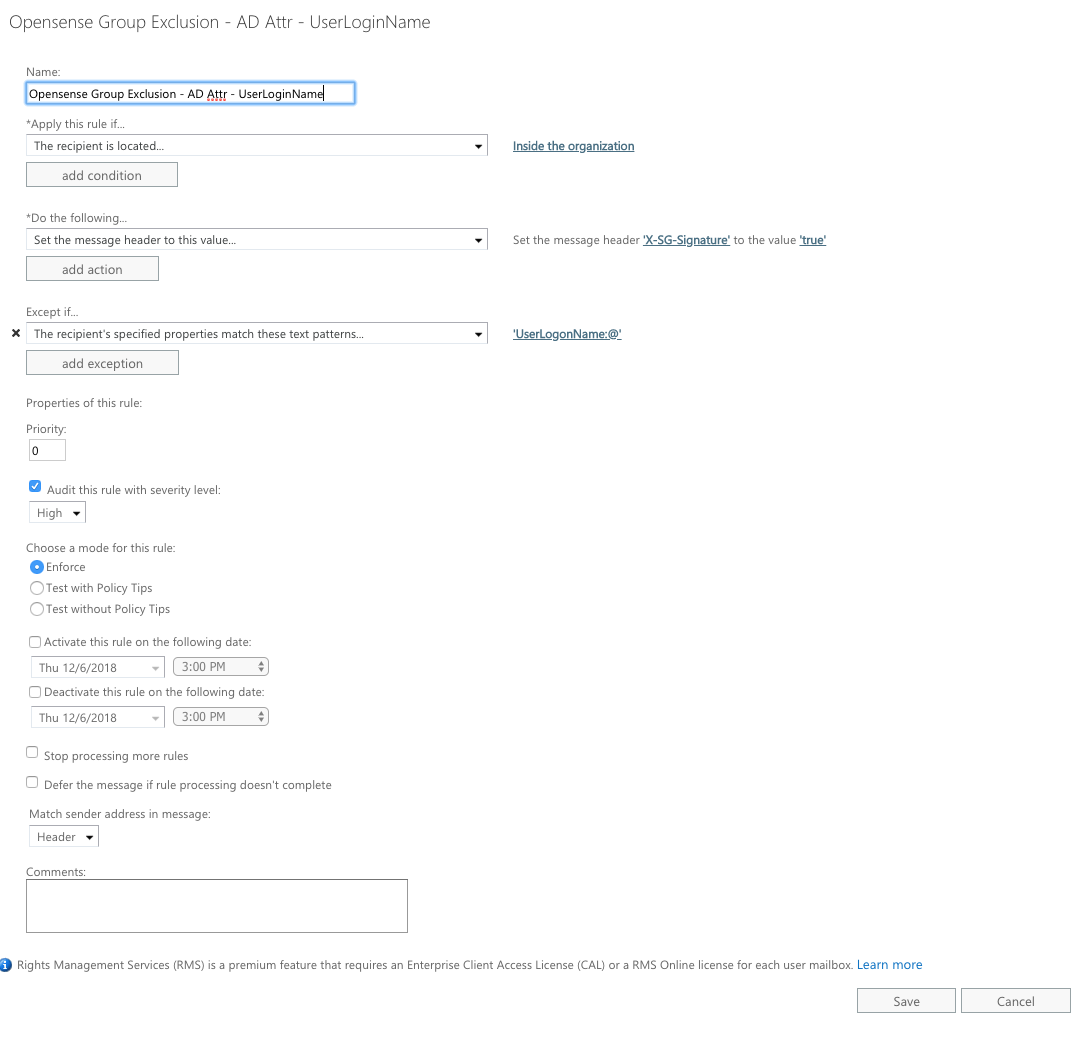
Section titled “How the rule works”The Opensense rule routes a message to Opensense only when the message doesn’t already have the X-SG-Signature header (see How does Opensense work with Microsoft 365?). The exclusion rule sets that header on messages to recipients inside your organization, except recipients whose UserLogonName attribute contains @, which are user accounts. So the header is set, and the Opensense rule skips the message, when the recipient is a group.
Create the rule in the Exchange admin center
Section titled “Create the rule in the Exchange admin center”- In the Exchange admin center, go to Mail flow > Rules, select Add a rule, and then select Create a new rule.
- Name the rule, for example
Opensense Group Exclusion - AD Attr - UserLoginName. - Under Apply this rule if, select The recipient > is external/internal, and then select Inside the organization.
- Under Do the following, select Modify the message properties > set a message header. Set the header
X-SG-Signatureto the valuetrue. - Under Except if, select The recipient > has specific properties matching these text patterns. Choose the UserLogonName attribute, and enter
@. - Set the rule settings as in the example: Enforce mode, severity High, and Match sender address in message set to Header.
- Save the rule, and make sure that it’s turned on.
- Give the rule a higher priority than the Opensense rule (priority 0 in the example), so it runs first.
To create the same rule in Exchange Online PowerShell:
New-TransportRule -Name "Opensense Group Exclusion - AD Attr - UserLoginName" -SentToScope InOrganization -SetHeaderName "X-SG-Signature" -SetHeaderValue "true" -ExceptIfRecipientADAttributeMatchesPatterns "UserLogonName:@" -SetAuditSeverity High -Priority 0The example below shows the same rule in the classic Exchange admin center, which Microsoft has replaced with the new Exchange admin center. The labels in the steps above are the current ones.
If you have any questions or concerns, contact help@opensense.com.
What’s next
Section titled “What’s next”- How does Opensense work with Microsoft 365?
- Using Outlook voting buttons with Opensense signatures: another case where you may want to keep Opensense off certain emails.