

Signatures on calendar invites and out-of-office replies
Overview
Section titled “Overview”Out-of-office (OOO) replies and calendar invites route through email servers owned by Microsoft (Microsoft 365) or Google (Gmail and Google Workspace), rather than your corporate email server, where Opensense is configured. This routing affects how Opensense can handle these message types.
Calendar invites
Section titled “Calendar invites”Opensense doesn’t stamp calendar invites by default, because of inconsistent behavior and functionality issues.
Why calendar invites aren’t stamped
Section titled “Why calendar invites aren’t stamped”Calendar invites are system-type messages, not standard emails, and shouldn’t be treated as emails. When Opensense processes them, several issues occur:
- Loss of functionality
- When Opensense touches a calendar invite, it converts the message into a standard email, so the message loses its calendar invite functionality.
- Inconsistent signature application
- Stamping can produce unexpected results. For example, if a signature user sends an invite to a non-signature user, who then forwards it, Opensense may apply a signature that mixes data from both users.
- Poor calendar display
- The plain-text block of the signature can appear in the calendar tile itself, which clutters the calendar view and makes a poor user experience.
This limitation applies to both Microsoft 365 and Google Workspace.
Out-of-office replies
Section titled “Out-of-office replies”OOO stamping works differently in Microsoft 365 and Google Workspace. These sections explain how each platform handles OOO replies, and what Opensense needs to stamp them.
Microsoft 365
Section titled “Microsoft 365”How Opensense identifies senders
Section titled “How Opensense identifies senders”By default, Opensense reads the MAILFROM: header to find which mailbox sent the email, and to apply the correct signature. When a user sends a standard email, this header holds their email address, and Opensense can match it to their account.
When Out-of-Office and automatic replies are sent, Microsoft Exchange leaves the MAILFROM: header blank. With this header empty, Opensense can’t identify the sender or apply the correct signature. This is why OOO replies are excluded from stamping by default.
What is required for OOO stamping
Section titled “What is required for OOO stamping”For Opensense to stamp OOO replies, all of these must be in place:
- Email authentication (SPF, DKIM, and DMARC). Your domain must have all three email authentication protocols configured correctly in your DNS. Without them, OOO replies send from a Microsoft address rather than the sender’s own address, which prevents Opensense from processing the message.
- A mail flow rule adjustment. Your existing Opensense mail flow rules must be adjusted to stop excluding automatic replies. By default, these rules exclude OOO and automatic replies from processing. An Opensense Implementation Engineer must make this adjustment.
- The Display From bypass. Because the MAILFROM: header is blank on OOO replies, Opensense must be configured to use the Display From address instead. This setting lets Opensense identify the sender when the MAILFROM: header is unavailable.
Workaround: Manual signature in OOO message
Section titled “Workaround: Manual signature in OOO message”If OOO stamping isn’t viable for your organization, users can add a signature directly to their OOO message when they create it.
- Use a text-based signature, rather than an HTML signature with images.
- Images can’t be uploaded to OOO messages. They either fail to save, or break immediately after.
- Copying and pasting a fully rendered HTML signature also fails. Images may break as soon as you save.
Google Workspace
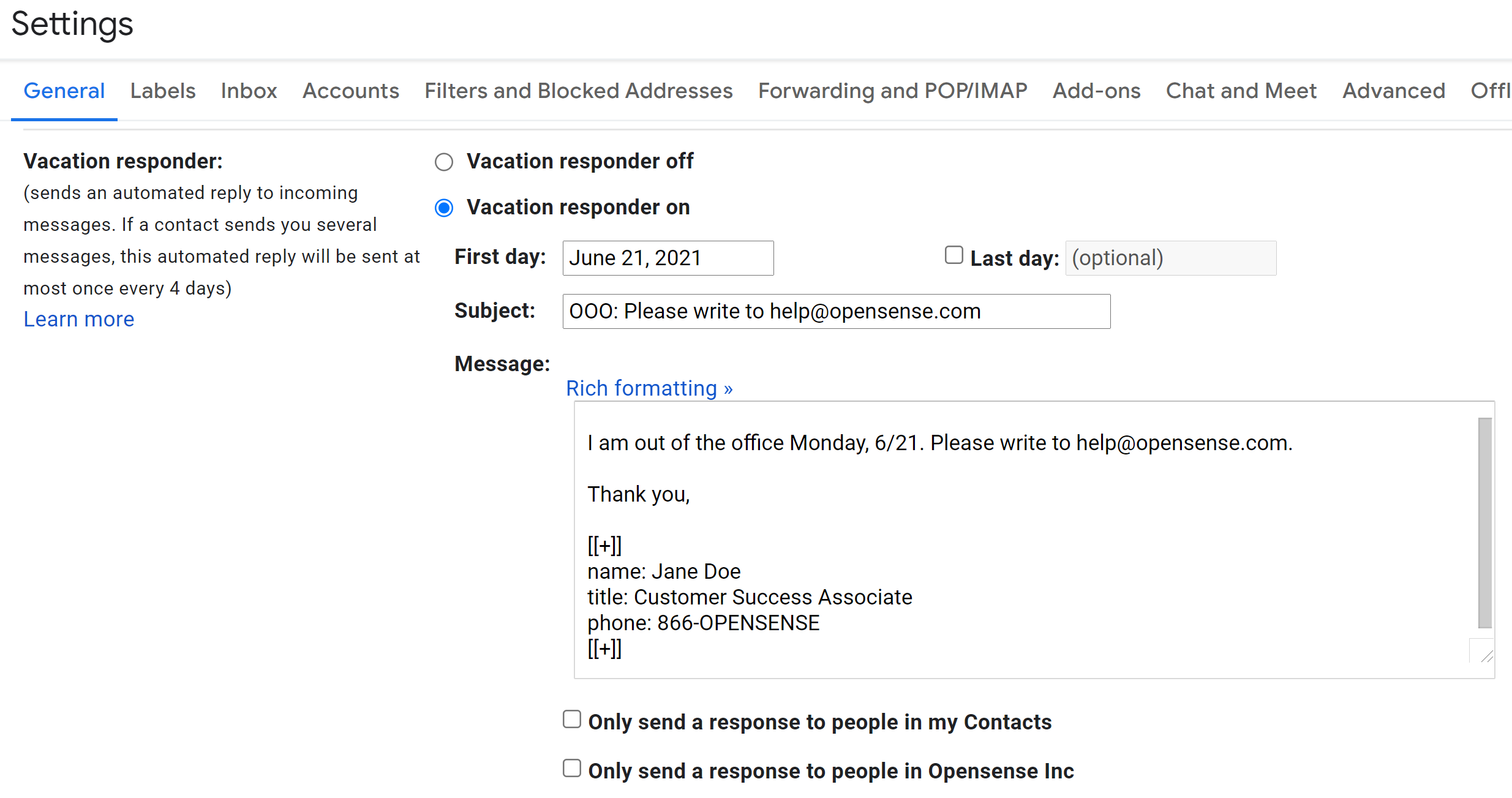
Section titled “Google Workspace”Google allows plain-text signature blocks in OOO messages. Users can enter the plain-text version of their signature directly in the body of the OOO message, and it routes normally, without additional configuration.
What’s next
Section titled “What’s next”For further help, contact Opensense Support at help@opensense.com.